Friday, May 6, 2011

Back to the garden

Wow, this takes me back—it’s from the North Vista lawn at the Huntington Gardens in November of 2005, the early days of Troubleshooting. We did captioned photos a lot back then, and this one’s pretty self-explanatory.


You know what Rob named that photo? “Statutory.” Couldn’t stop him if I tried.

In any case, that was a wonderful visit—we made it around the entire 120-acre garden in one go and even had time left over to crash the famous Rose Garden Tea Room. After all, what could possibly be more English than a little brown rabbit coming to tea? Yum, fresh scones with marmalade and Devonshire cream!


But now that it’s been five-plus years since that trip to San Marino, we figured we were due to return—overdue, really, considering they opened the Chinese garden back in 2008. Around here, Japanese gardens are pretty common (we couldn’t go anywhere last summer without running across one), but authentic Chinese gardens are harder to come by. And judging by this model in the main entranceway, it should be pretty impressive!


So from the Huntington entrance, we head north past the far side of the conservatory, and there we find Liu Fang Yuan—the Garden of Flowing Fragrance—cordoned off by the rippling Jing Yun Bi, the Wall of the Colorful Clouds. Looks promising, doesn’t it?


And here’s what lies within! Sure enough, the garden is suffused with the scent of jasmine, but it’s the views that really take your breath away. Across the Lake of Reflected Fragrance, we see the Pavilion of the Three Friends, the Jade Ribbon Bridge, and, in the background, the Love for the Lotus Pavilion. And in the foreground, the Rabbit of a Thousand Daytrips.


Why all the flowery names? It’s because poetry has a very literal presence in Chinese gardens, both in the names of things and in actual inscriptions etched in various places throughout, such as here on the Bridge of Strolling in the Moonlight.

I mean, you didn’t think I go around doing linguistically appropriate tagging or something, did you?


As another example, the brochure says the couplet on the Love for the Lotus Pavilion translates as:
Though rooted in the mud, how could the lotus be sullied?
Its fragrance spreads far with even greater purity.
...which I’m assuming is the text you can sort of make out in this shot, along with the little girl I’m waving back at from the Bridge of Verdant Mist.

Oh yes, the multiple bridges. Chinese gardens are highly architectural, traditionally enclosed by at least one wall (as you’ve seen) and then partitioned into multiple vistas by a variety of structures. The Lake of Reflected Fragrance is spanned by no fewer than five bridges, each completely different in size and design. Well, why not, right?


Even the natural elements are used differently than they are in Japanese gardens. Chinese gardens tend to have larger, more centralized water features and plants that are selected first and foremost for their symbolic meanings—pine for longevity, peonies for wealth, lotuses for purity, and so forth. The Pavilion of Three Friends is so named for its placement near a grove of pine, bamboo, and plum blossoms, all of which thrive during the winter and early spring and therefore are seen as symbols of resilience and strength of will.

Okay, yeah, I’m just taking the brochure’s word for some of this.


But perhaps the most distinctive and readily identifiable characteristic of Chinese gardens are the “scholar’s rocks,” those quirky pieces of pockmarked stone that recall the jagged mountains of China and are mounted on pedestals like nature’s own abstract art. Carvings or markings on scholar’s rocks are generally frowned upon, so what you see is, in all likelihood, the way they were found.

I suppose if I had to be upstaged by a chunk of limestone, this is a pretty good one.


Now, something that Chinese and Japanese gardening do have in common is the cultivation of miniature trees, except where the latter’s art of bonsai likes a more manicured look, the former’s penjing favors it on the naturalistic side—bushier boughs, roots that grow over rocks, that sort of thing. But either way, I get to feel like a giant for a change, so hey.


A full circuit around the lake eventually brings us to the rounded portals of the Terrace of the Jade Mirror, the “jade mirror” being a reference to the full moon, which was sometimes compared to a mirror of white nephrite. Four different views, depending on which way you face, or—as in this case—you can have two parties using it as a cool photographic backdrop in two different directions simultaneously!


And having circled around to our starting point, I think it’s time for a snack at the teahouse. Last time it was a proper English tea on an autumn afternoon, this time it’s lakeside dim sum on a beautiful spring day. It’s hard to lose here, isn’t it?


Unfortunately, we weren’t able to go through the Japanese garden for comparison during this visit—it’s currently undergoing renovations, and this was as close as we could get to it today. If it’s not one thing, it’s another...


...but then again, I suppose we could just return in another five years! Well, in the meantime, remember it this way, and we’ll see what 2016 brings!

Sunday, April 3, 2011

Spring can really hang you up the most

LA may not need a winter thaw like other parts of the country, but that doesn’t mean there isn’t still a malaise when the rainy season lingers a bit too long. Laugh all you want about the way Angelenos treat a drizzle like it’s the endtimes; drive among us on those days, and you’ll swear it is too.

My solution? Stay in as much as possible during the wet season and work on stuff at home. Hey, the bathroom needed retiling anyway.


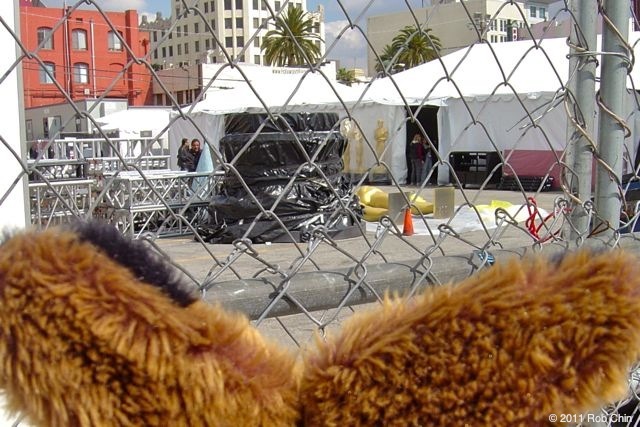
This hasn’t been the rainiest year I’ve ever seen, but the storms that did blow in tended to be atypically swift and brutal—as Southern California goes, anyway—and while the tents that were set up for the Academy Awards ended up not being all that necessary, there’d been enough rain in the days immediately preceding the Oscars that it sure seemed like they would be!


And speaking of Oscar preparations, here’s a peek at the infrastructure you don’t usually see. Those giant prop statues don’t go up and come down through CGI, after all. Better get a move on, guys!


Anyway, this season has been marked by some of the most seesaw weather in recent memory—one week, chilly rain, the next a mild heatwave, then back again. But cabin fever will out, so one day Rob and I braved the on-and-off rain to visit the William Andrews Clark Memorial Library in the West Adams district—originally the residence of W.A. Clark, Jr., heir to his senator father’s mining fortune, it’s now one of UCLA’s off-campus facilities.

Almost looks as if we’re south of Tidewater rather than south of Pico, doesn’t it?


Thirty seconds after that shot was taken, it started coming down again, resulting in a rather undignified sprint across the lawn. Hey, fur takes forever to dry, I do what I have to to avoid getting it wet. First thing we saw after bolting inside? The foyer ceiling mural. Ooh, Sistine-y. I love these random eye-candy libraries we keep coming across.


Most of the modern working space at the Clark is in the basement, leaving the upstairs space largely the way it looked as a functioning 1920s home. The drawing room now serves as a lecture hall, while the Italian Renaissance-styled reading rooms remain open for display. They’re pretty magnificent, and it’s no surprise the library is occasionally used for filming. Now, where’s that recovered text on the Priory of Sion?


No, I kid about that. But as a working research library, the Clark genuinely does specialize in rare books and fine printing of all sorts, from medieval manuscripts and Shakespeare folios to Old West publications and early newspapers. The highlights, though, are its collections of 17th- and 18th-century British books as well as the world’s largest collection of Oscar Wilde materials—not just his published works, but his correspondence, photographs, and even his playbills and news clippings!


And the best part of this visit? Getting to leaf through Wilde’s very own journals, including this draft of An Ideal Husband. Turns out Wilde was a bit of a doodler. Who knew? But to think I touched the notebook touched by the hand that touched Bosie—I bet not every rabbit gets to do this.


For that matter, if our tour guide is to be believed, not a lot of rabbits see the Watts Towers firstpaw either! The Towers are one of those singular landmarks that are locally iconic just because they’re, well, weird—are they sculpture, architecture, naïve art, all or none of the above? That debate’s above my pay grade; I just came here on a sunny day to admire them!


The Towers’ story is as unique as they are: Essentially a backyard art project, they were constructed between 1921 and 1954 by one man, Simon (né Sabato) Rodia, a construction worker from Italy who settled in Watts and—for reasons known only to him, if then—began building the work he called Nuestro Pueblo out of steel piping and rebar, held together with nothing more than wire mesh and a special mortar Rodia devised.

And that’s just the beginning of the quirkiness...


As instantly recognizable as they are from a distance, appreciating the scale and detail of these things up close is a whole other experience. The two tallest towers are nearly 100’ in height, yet Rodia built them without scaffolding, using nothing more than a window washer’s belt to clamber up and down these massive things. And the man himself was only 4’11”!


Moreover, while the big towers are the most identifiable part of the entire complex, there are actually seventeen distinct structures, including this gazebo, where Rodia apparently allowed the neighbors to conduct baptisms despite being a lapsed Catholic himself. In fact, one theory behind the Towers’ inspiration is the Festa dei Gigli Rodia might’ve seen in his childhood, but really, everything is so abstract that I think you can see pretty much whatever you want in them. The big towers often draw comparisons to Gaudi’s Sagrada Familia (or gothic cathedrals or minarets), the gazebo kind of looks like the framework of a stupa, and some of the finer details are reminiscent of West African metalwork...the list goes on and on.


Then there are the mosaics, both the ones embedded in the metal structures and those in the outer walls. Rodia made them from whatever was available—ceramic tiles and fragments, volcanic rock, seashells, bits of colored glass. (Up close, you can see a lot of 7-Up bottles and the occasional Milk of Magnesia.) Rodia would even pay the neighborhood kids for materials, resulting in more than one set of broken wedding china!


This was a top-to-bottom project, too—check out the groundwork patterns in the multicolored concrete walkway. Easy to overlook at human heights, mesmerizing at mine.


But the craziest thing of all? Rodia did all of this with only the simplest hand tools, like those imprinted in the cement wall here. No machine equipment, no bolts or rivets, no welding, not even drawn designs. Mind-blowing.

The second craziest thing is that he then abandoned the property in 1955—handing it over to a neighbor for virtually nothing—and relocated up north to Martinez, where he died a decade later without ever setting eyes on his magnum opus again. Since then, Rodia was immortalized on the Sgt. Pepper’s cover, poking out from behind Bob Dylan, and the towers themselves survived the Watts Riots, threats of demolition, and multiple earthquakes until finally being designated a National Historic Landmark in 1990. All of which culminated in this year, when it received visits from not only me but Homer and Marge as well. Not a bad legacy!


So having covered literature and art, how about a nature break? Descanso Gardens was holding a cherry blossom viewing, and far be it from me not to crash it! You may remember that we visited Descanso last summer, but early spring is clearly the best time to see it: Here’s the same spot during two separate visits (note the bridge) and you can see the difference is like night and...well, like July and March!


Wow. Look at the lily magnolias and crabtrees! I feel like I’ve photobombed an allegorical painting or something.


As for the cherry trees, this one just off the main lawn was the biggest attraction in the entire garden!


Up close, though? The flowers’ fragrance was much lighter and less sweet than I expected. Still, it was enough to put me in a haiku mood:

Spring cherry blossoms
Thought they’d smell more like Kool-Aid
DC trip: canceled


Also wildly popular: the lilac grove, which was pretty much inert back in July. Not so, this time—a rabbit could lose himself in clouds of flowers now!


And to cap it off, we swung by the promenade—nothing says the arrival of spring and the coming of Easter like fields of bulb flowers! Again, I won’t pretend that waiting out winter-to-spring ennui is harder here than most places, but that doesn’t make this any less welcome a sight. Especially with more rain in the forecast...


Well, I’m off to go hoard chocolate eggs and jellybeans. Hey, once Easter’s over, it’s another six months until the next major candy holiday!

Thursday, March 3, 2011

Tasting tour

I’m not a food critic, and never could be—my palate’s what you’d call rustic—and the same for Rob, who’s a bit averse to being photographed and kicked out of restaurants by jumpy proprietors. Even so, we do love casual dining, which is why the “Rabbit Food” series has been a cornerstone of Troubleshooting from the start. And while we’re certainly not above chains or fast food or openly hovering around the display case at Grand Lux Café’s dessert counter, this entry is about catching up on some of the local places we’ve visited in the last year...and may well visit again.


The thing about LA is that you can find pretty much any cuisine here—if you’re willing to make the drive. Conversely, I don’t think the city has a true signature dish the way Chicago has pizza, Philadelphia has cheesesteaks, or Baltimore has crabcakes—though it is recognized as the birthplace of the French dip! Perhaps not surprisingly, there’s a long-standing dispute over which century-old establishment invented it, but frankly, I’m only interested in the food itself. Both places are downtown, so we started at Philippe’s near Olvera Street, a deli with communal tables, sawdust on the floor, and other touches that make it look like it’s gone unchanged for fifty years or more. And they still have coffee for 9¢ a cup!


As for the actual sandwich? I thought I’d try it bare-bones, just a “wet-style” sandwich that came pre-dipped. But I kind of liked it that way, since it retained enough of the earthy au jus to have an, I don’t know, elemental quality to it. Unflashy, sure, but you could see how the idea caught on, and the spicy house mustard gave it a light but satisfying kick on top of that.


The other claim to the French dip belongs to Cole’s, over in the Pacific Electric Building on 6th St. Like Philippe’s, it opened in 1908, but it’s a pub rather than a deli, and because Philippe’s changed locations more than once, it’s Cole’s that reigned as LA’s longest continuously operating restaurant until it closed temporarily for remodeling in 2007–2008.


The remodeling makes it look more polished (if no less retro) than Philippe’s, but how’s the dip stack up? Truthfully, even with Swiss cheese added, I found the meat flatter and less savory than Philippe’s. But what I’d come back for were the sides, both the garlic fries—so garlicky I could still taste them on my whiskers the next day—and the “atomic pickle,” with its sweet and zesty but not bitingly hot zing...


...because despite getting several extra pickle spears to go, my brothers promptly laid waste to them, then insisted we immediately head back for more. Next time, guys!


French dip investigation aside, we also checked in with some other local institutions. Take the Pig & Whistle, which hosted the first Oscars party and was namechecked in Chinatown: As much as the surrounding Hollywood neighborhood has changed over the decades, it’s stood fast, give or take a restoration, and the menu is still dominated by good old pub food...even if the glass-bottle Cokes of my prior visits are apparently a thing of the past. But no complaints about the chicken pot pie, which comes with its flaky crust cut sandwich-style so all that steamy filling can literally spill out. It may not be a traditional presentation, but it checks all the other boxes!


Then down on Sunset is a newer haunt for starving actors and struggling artists, the Griddle Café. And part of what makes it popular is the out-of-control portions—as generous as the Crème de la Crème French toast here may look with its graham cracker crust and cheesecake topping, the pancakes spill over the plate, and even a human-size appetite can make two or three extra meals out of the leftovers. Plus for a few more bucks you can get real sausages on the side, not wimpy breakfast links like most places would sell you for the same price.


And right across the street from the Griddle Café is the Hollywood installment of the Counter, a burger place where you can truly have it your way—walk in and they hand you a checklist where you can choose your meat, your bun (or lack thereof), your sauces, and your toppings. Here I went for a grilled chicken breast on a multigrain bun with Asian-leaning flavors: ginger-soy glaze, horseradish cheddar, scallions, cucumbers, and mixed greens, with fried onion strings on the side and an apple pie shake. But only because the even better churro shake wasn’t available that day.


Obviously, though, LA’s not hurting for actual Asian food. On the way to Griffith Observatory, we stopped off for a late lunch at Chi Dynasty for some good old-fashioned sesame chicken. No frills here...but then about ten seconds after my first bite, the heat of the chiles and the pungency of the sauce hit me and I drained half my soda. That’s the way to do Chinese!


Not far from Chi Dynasty is Little Armenia/Thai Town—the two overlap and blur—which is where you’ll find Jitlada, tucked away in a strip mall. They specialize in southern Thai cuisine, and while I understand mussels aren’t traditionally southern, who could resist these pretty New Zealand green mussels, served up in a light curry broth with basil and lemongrass? Mmm!


Rolling down the hill to Santa Monica Blvd., we come to Marouch, a Lebanese-Armenian eatery not far from Hollywood Forever. These are the makings for chicken shawarma with a delicious garlic sauce, but I’d be remiss if I didn't give a shout-out to the appetizers as well, especially the pickled turnips—seriously—and the yummiest hummus I’ve had to date.

Side note: This was actually my second time at Marouch (afternoon lighting screwed up the first shoot), but not only did owner Serge remember me from months earlier, he remembered which table we sat at and made sure we were away from the windows this time! A rabbit never minds a little personal attention, but that was above and beyond. Thanks, Serge!


We don’t do Ethiopian food a lot since Rob doesn’t care for injera, but once in a while he can be nagged into going to Nyala in Little Ethiopia. And it’s worth it when the doro tibs—shredded chicken in a tomato sauce flavored with a berbere spice blend and niter kibbeh butter—and green salad are this tasty. It’s just more of a challenge with paws, is all.

I’m gonna need a few more napkins in a minute.


How about giving the new mozzarella bar a try? Obikà in Century City imports its stuff straight from Italy three times a week, so it’s almost as fresh from the water buffalo’s udder as it can be. This is the smoked affumicata mozzarella with salame felino; it may not look all that filling, but one, it’s meant to be savored rather than bolted, and two, a little bite of everything—including the cherry tomatoes and greens—goes a long way, particularly with the rich, smoky flavor of the cheese. That said, next time I’m getting the stracciatella di burrata—the sweet, ricotta-like variation—next time. It’s even better!


Southwards of Obikà is an old favorite of Rob’s, Empanada’s Place in Culver City. There used to be one in West Hollywood, closer to us, but these days we suffer the mileage because we love a turnover in any language—calzones, böreks, piroshki, we’re there. And for the Argentinean empanada, this place offers nearly twenty different fillings, but when I go, I usually just stick with a basic trio of beef, chicken, and spinach (you can distinguish them by their shapes and crimpings). And then get one of each of the rest for takeout.


Further abroad, on our way back from the South Coast Botanic Garden last summer, we swung by King’s Hawaiian in Torrance—and since I couldn’t make up my mind, I wound up ordering an entire Royal Platter! This is the way to go if you prefer picking at appetizers over working through an entrée, because they’re all here: fried calamari, kalua pork nachos, teriyaki beef, mini chicken skewers, even Spam sushi! All that plus an aquarium-side view—but hey, that was a long shoot, I earned it.


Strangely, it’s hard for me to pick specific favorites among restaurants, but I suppose when it comes down to it, Oumi Sasaya in Lomita is a likely contender. It’s not just the size of their shrimp udon—the angle of the photo really belies what a huge cauldron this was—it’s that the mochi tempura turns into the chewiest dumpling in the broth and is so good that Rob and I both dreamed about it days later and had to go back at the next opportunity. And will again, undoubtedly.


When all is said and done, however, sometimes you just want something simple. And in Southern California, that typically means a trip to In-N-Out Burger. Is it the best hamburger in the world? I’ll let you know when I’ve tried them all, but in the meantime, just give me an Animal-style 3x3 with a vanilla shake and all is well.


Don’t worry, I’ve left room for the best part of any meal—dessert! You may remember that back in September I mentioned the black sesame cream puff at Patisserie Chantilly (right next to Oumi Sasaya!) as well the shave ice at Stewie’s in Glendale (now sadly closed). More recently, I stopped by West LA’s tiny Churros Caliente, and as good as their chicken panini with reggiano was, I clearly came for the fresh churros! They’re made to order and served Spanish-style here—that is, with a dipping cup of thick, creamy hot chocolate that’s a house blend of cacao beans with just enough milk and sugar to retain some subtle floral notes without making it overly sweet like everyday cocoa. And there was enough left over from dipping for one good chug!


Also fun: Tokyo Table in Arcadia, which surprised me with its massive “honey toast”—huge slices of bread that are cubed, toasted, and topped with vanilla ice cream and caramel sauce! Not very Japanese? Who cares!


But even more decadent than that? Going to the Fair Oaks Pharmacy, a soda fountain in South Pasadena that’s so old-timey that it’s literally on Route 66. Nice place to have a grilled cheese and a lime phosphate, but then it was down to business with a Banana Blitz, which seems pretty self-explanatory. I...am a lucky rabbit.


And so it goes when I dine out—nothing terribly fancy, nor does it have to be. But to be honest, looking back at everywhere I’ve been in the last year kind of makes me want to put my paws up for a bit, so maybe I’ll just order in tonight. Feel free to stick around if you want, though—what do you like on your pizza?